Why domain authority scores disagree: DR, DA, Authority Score and OAR
Published
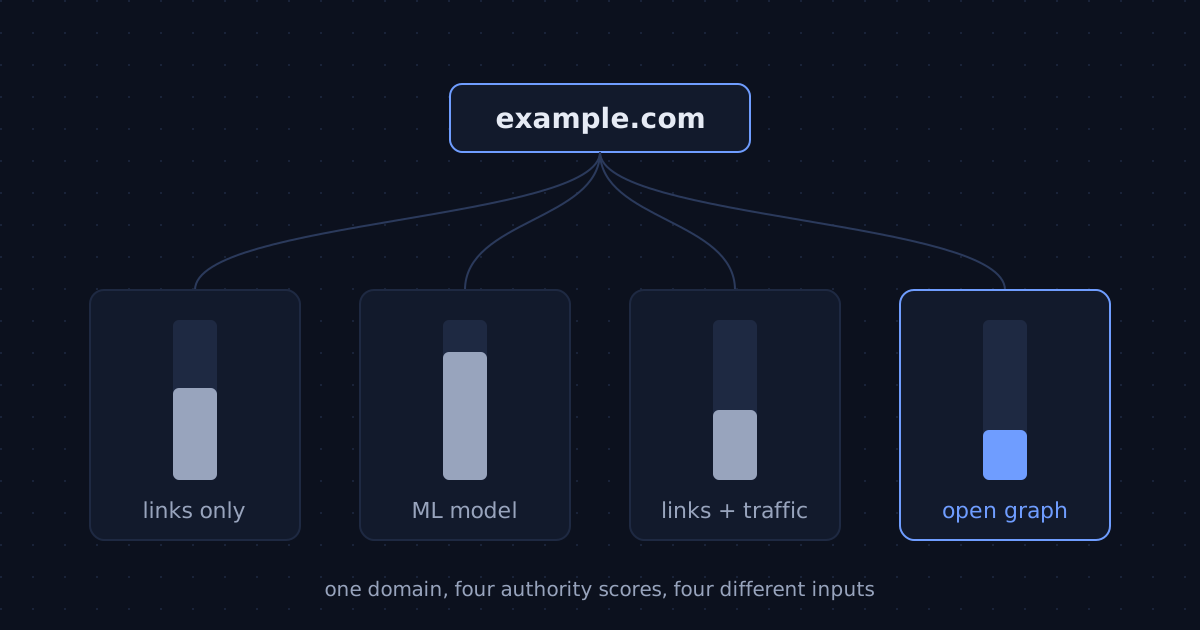
Look up the same domain in four tools and you will usually get four different numbers. A site can sit in the 40s on one scale, the 50s on another and the 20s on a third, and none of the tools is broken. They are answering different questions, from different data, on different curves. Once you know which question each score answers, the disagreement stops being confusing and starts being useful.
This article lays out what the four best-known domain-level authority scores are built from, why they diverge, and how to read them without fooling yourself. One of them is ours, so we will be explicit about what it does not do as well.
Four scores, four different questions
Each vendor describes its own metric publicly. Summarised from those descriptions:
| Score | Built from | Scale and notes |
|---|---|---|
| Domain Rating (DR) Ahrefs | Ahrefs' own crawl: unique domains with at least one followed link | 0 to 100, logarithmic. Ignores traffic and age; does not filter spam links. |
| Domain Authority (DA) Moz | Moz's own link index, fed to a machine-learning model | 1 to 100. Built to predict how likely a domain is to rank; formula not published. |
| Authority Score (AS) Semrush | Backlinks, estimated organic traffic and spam signals | 1 to 100. Mixes link power with traffic and a natural-profile check. |
| Open Authority Rating (OAR) domainrating.org | Common Crawl's public domain graph: harmonic centrality and PageRank ranks | 0 to 100, logarithmic. Reproducible from public files; links only. |
Ahrefs explains Domain Rating as a link calculation: it finds every domain with at least one followed link to the target, and each of those passes on a share of its own rating divided by the number of domains it links to. Only the first link from each domain counts. Ahrefs itself notes that DR does not look at traffic and does not filter spam, so a pile of low-quality links can raise it.
Moz describes Domain Authority as a score that predicts how likely a domain is to rank, produced by a machine-learning model over its own link index. Because it is a model trained against search results rather than a published formula, you cannot recompute it yourself.
Semrush’s Authority Score blends three things: link power, an estimate of organic traffic, and a set of “natural profile” checks that look for signs of manipulation, such as a site with many links but no rankings, or many referring domains on the same network.
The Open Authority Rating on this site uses only the public link graph that Common Crawl publishes roughly monthly. Each domain has two ranks in that graph, harmonic centrality and PageRank, and OAR combines them at 0.7 and 0.3 on a logarithmic curve. The methodology page has the exact formula, and the data page shows how to reproduce any score from the raw file.
Why the numbers diverge
Different crawls see different links
Every link-based score is only as complete as the crawl behind it. Ahrefs, Moz and Semrush run their own crawlers and keep private indexes of different sizes and freshness. Common Crawl is a separate, public crawl. A link that one crawler found and another missed simply does not exist for the second score. Smaller and newer sites feel this most, because a handful of missed links is a large share of their profile.
Different inputs, not just different weights
DR and OAR look only at links. Authority Score adds estimated traffic, so a site with modest links and strong search visibility will score relatively higher there. DA is fitted to predict rankings, so it absorbs whatever its model finds correlates with ranking. Comparing them is closer to comparing height, weight and shoe size than to comparing three rulers.
Different curves
Links on the web follow a power law: a few domains attract most of them and everything else sits in a long tail. That is why these scores are logarithmic or close to it, and why the top of each scale is so compressed. Going from 20 to 30 and from 70 to 80 are not the same amount of progress, and the step size differs between tools. On OAR the median domain scores in the low single digits, so a 40 is already a strong position.
Different resistance to manipulation
A cluster of low-value sites all linking to one target can inflate raw link counts and PageRank-style signals. Harmonic centrality, which measures how close a domain is to the rest of the web, barely moves in that case, which is why OAR weights it at 0.7. Authority Score tackles the same problem from another side with its spam checks. DR, by Ahrefs’ own account, does not filter it.
Different refresh cycles
The commercial indexes update continuously. OAR changes once per Common Crawl release, and each release is built from about three months of crawling. A link you earned last week can appear in one tool long before another notices it.
How to read authority scores without fooling yourself
- Compare within one metric only. A 45 on one scale and a 38 on another say nothing about each other. Put candidate domains side by side on the same score, for example with the compare tool.
- Watch the trend, not the number. A score that rises steadily across several updates is more meaningful than any single reading.
- Look underneath. Before trusting a number, check how many distinct domains actually link to the site and whether they are real sites people visit.
- Be suspicious of sudden jumps. A large rise in one tool that no other tool reflects is often a burst of low-quality links, not real authority.
- Remember none of them is a search engine signal. These are third-party estimates. Google has its own systems and does not use any of these scores.
Using scores when you buy a domain or a link
Authority scores are most often consulted when money is involved: buying an expired domain, paying for a sponsored placement, or picking partner sites. In those cases, check the score on more than one tool, read the trend, and look at the site itself. A domain whose old content has been replaced by thin pages can keep a respectable score for months. Before you pay, it helps to keep a dated record of what the site looked like when you evaluated it; a screenshot API such as Screencap.site can capture the page so you can show later exactly what you were sold.
Where OAR fits, honestly
OAR is free, its inputs are public, its formula is published and the scores are released under CC0. Anyone can check a number against Common Crawl’s files. That is its whole point. It also has limits we want readers to know: it is domain-level only, it measures position in the public link graph rather than content quality or traffic, new and very small domains often have too little data for an honest number, and it predicts nothing about search rankings. Use it as one transparent reference point next to the commercial tools, not as a replacement for judgement.
You can check any domain’s OAR on the home page.
domainrating.org is not affiliated with Ahrefs, Moz or Semrush. Domain Rating, Domain Authority and Authority Score are trademarks of their respective owners and are named here only to describe how those metrics differ from OAR.