What is a good domain authority score? What the numbers really mean
Published
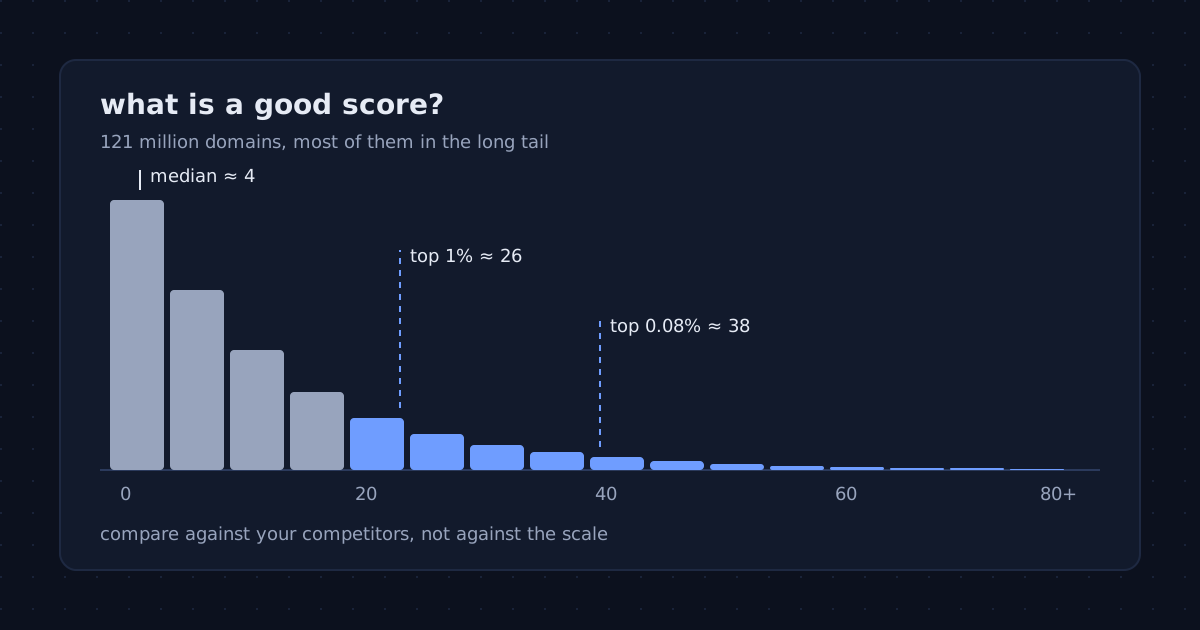
“What is a good domain authority score?” has no single number for an answer, but it does have a clear one. A good score is one that is strong for the job you want the domain to do and compared with the sites you actually compete with. Before you can judge that, you need to know what the numbers mean on the scale you are reading, because authority scores are built to be anything but evenly spread.
This guide uses the Open Authority Rating (OAR), whose method is published in full. Commercial scores such as Ahrefs DR or Moz DA use their own data and curves, so their numbers do not translate one to one; our article on why the scores disagree explains the differences. The reasoning below applies to all of them.
The scale is a long tail, not a school grade
Links on the web are wildly unequal: a small group of domains attracts most of them and everything else forms a very long tail. If the score were linear, all but a few million domains would read zero. OAR is logarithmic instead, so each tenfold step in a domain’s rank in Common Crawl’s graph of more than 120 million domains moves the score by about 12 points. The result is that a 40 is not “forty percent”: it is already a very strong position.
| OAR | Rank in the graph | Where that sits |
|---|---|---|
| 4 | the median domain | half of all domains score higher |
| 13 | 10,000,000 | top 8% |
| 26 | 1,000,000 | top 0.8% |
| 38 | 100,000 | top 0.08% |
| 51 | 10,000 | top 0.008% |
| 63 | 1,000 | top 0.0008% |
Read it from the top: the median domain scores around 4, a domain in the top 1% of the graph scores in the mid twenties, and only about 100,000 domains score 38 or more.
So what counts as good?
Three honest rules of thumb follow from that table:
- Any score above the low single digits means real links. The domain is known to the wider web, not just present in it.
- The twenties are a strong small or specialist site. Being in the top 1% of a graph that size takes a steady stream of independent links.
- Forty and above is the territory of established brands and publishers. For most businesses it is not a realistic target, and it does not need to be.
A new site scoring nothing, or having no score at all, is normal too. New and very small domains often have too little presence in the graph for an honest number, and appear once other sites start linking to them.
Compare against your competitors, not against the scale
The useful question is not “is 22 good?” but “is 22 good for a regional accountancy firm?”. Pick the five or six sites you actually compete with for customers or links and look them up. If they sit between 15 and 25, a 22 is strong; if they sit in the forties, it is a gap worth understanding. Comparing domains side by side makes this a one-minute job, and the top domains list shows what the very top of the scale looks like.
To turn that comparison into a benchmark, sort the group by score and take the middle value as your realistic target and the leader as the ceiling. Being at the median means the web treats you as a normal member of your field; closing the gap to the leader is a multi-year job, so measure progress in releases, not weeks. Recheck the group every few months, because competitors move too.
The same applies when you judge a site you might get a link from or advertise on. If you earn from links and recommendations yourself, as in Online Money Blog’s guide to promoting other people’s products, relative authority is what matters: a partner in the top quarter of your niche is worth more than a higher number in an unrelated one.
Look at the direction, not just the number
A score is a snapshot of one crawl release. A 24 that has climbed for a year and a 24 that was a 30 last spring describe very different sites. The domain page shows the score across releases; our guide to reading an authority trend explains what steps, slides and gaps mean.
What a good score does not tell you
Authority scores measure position in the link graph. They do not measure content quality, traffic or whether a site is trustworthy, and none of them, ours included, predicts search rankings. A specialist site with a modest score can outrank a famous one on the searches that matter to it. Treat the score as one signal among several, especially when money is involved.
How to raise it, honestly
You cannot buy an OAR, and scores are never adjusted by hand. The only way up is to earn links from sites that are themselves well connected: publish things others want to cite, be useful to the communities around your field, and get mentioned where your customers already read. Because the scale is logarithmic, expect slow movement; every step up means overtaking a large number of other domains.
The short answer
On OAR, a score in the twenties already puts a domain in the top 1% of the web, and forty-plus is rare. Whether a score is good for you depends on your competitors and on its direction over time. You can look up any domain to start.
OAR measures a domain’s position in the public link graph. It does not measure content quality, traffic or trustworthiness, and it predicts nothing about search rankings. Domain Rating and Domain Authority are trademarks of their respective owners.