What is harmonic centrality? The link-graph measure behind domain authority
Published
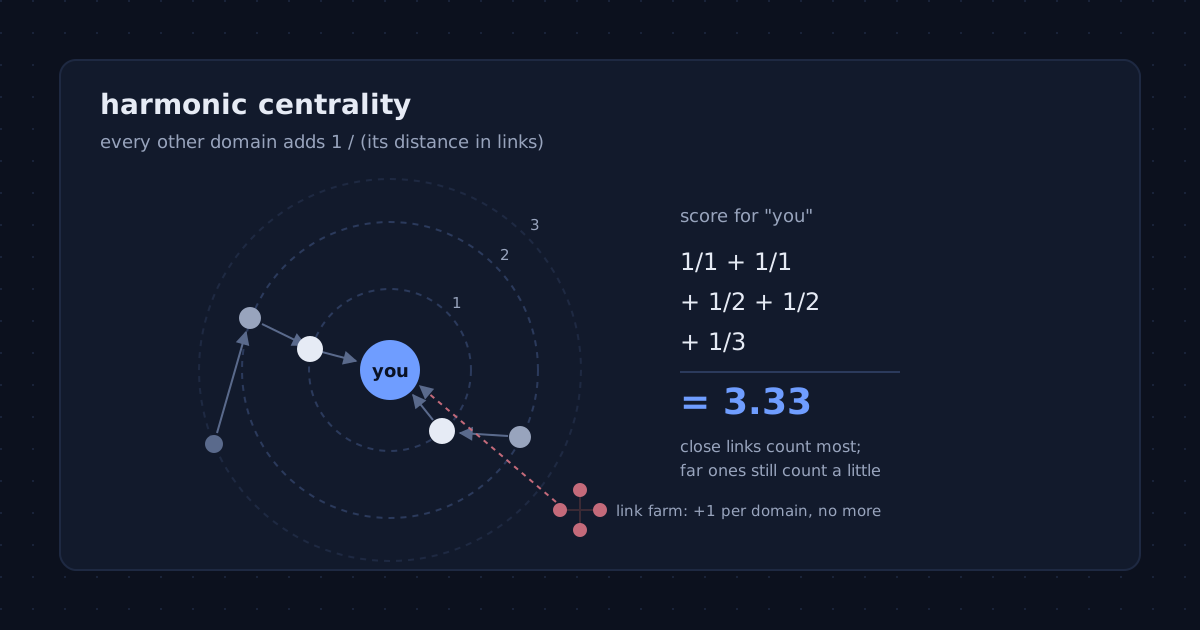
Harmonic centrality is a way of measuring how close one point in a network is to all the others. On the web, the points are domains and the connections are links, so a domain’s harmonic centrality says how few clicks separate it from the rest of the web. It is the signal that carries 70% of the weight in every Open Authority Rating (OAR) on this site, and it is the reason the score is hard to inflate with cheap links. This article explains what the measure is, works through a small example, compares it with PageRank and shows how it becomes the number on a domain page.
The definition in one sentence
A domain’s harmonic centrality is the sum, over every other domain, of one divided by the length of the shortest chain of links from that domain to it. A domain that links to you directly is one link away and adds 1. A domain that links to a site that links to you is two links away and adds 1/2. Three links away adds 1/3, and so on. A domain with no chain of links to you at all adds nothing.
Two things follow from that definition. Every domain that can reach you counts, not only the ones that link to you directly, so the measure sees the whole web rather than a list of backlinks. And nearer domains count more than distant ones, but distant ones never stop counting entirely, which is what makes the result stable as the web grows.
A worked example
Take the small graph in the illustration above. Two domains link straight to the domain marked “you”, so each adds 1. Two more link to one of those, which puts them two links away; each adds 1/2. One more domain sits three links away and adds 1/3. The total is 1 + 1 + 1/2 + 1/2 + 1/3, or about 3.33.
Now compare two ways of raising that number. A new direct link from any domain adds up to 1, and if that linking domain is itself close to many others, it also shortens their paths to you, so every one of them now adds a larger fraction. A link from a domain that nothing else links to adds exactly 1 and shortens nobody’s path, because no other domain can reach you through it. That asymmetry is the whole story of why the measure rewards links from well-connected sites.
On the real web the same sum runs over the more than 120 million registrable domains in a Common Crawl release. A well-connected domain collects a contribution from a very large share of them, which is why its score is so hard to move by adding a few hundred extra links of any kind.
Why the reciprocal matters
An older measure, closeness centrality, adds up the distances themselves instead of their reciprocals. That works on a small, fully connected network, but the web is neither: many domains cannot reach many others at all, and an unreachable domain has an infinite distance that wrecks the sum. Taking one over the distance turns “unreachable” into a clean zero, so harmonic centrality is well defined on a web with dead ends, islands and one-way links.
That property is a large part of why researchers favour it for web graphs. In Axioms for Centrality (Internet Mathematics, 2014), Paolo Boldi and Sebastiano Vigna tested the classic centrality measures, PageRank among them, against a small set of properties a sensible ranking should have, and harmonic centrality was the one that satisfied all of them. Common Crawl publishes a harmonic-centrality rank for every domain in its web graph releases, which is what lets anyone compute it at web scale without building their own crawler.
Harmonic centrality vs PageRank
PageRank, the measure Google was founded on, also looks at the whole link graph, but it asks a different question. It imagines a surfer clicking links at random and measures how often that surfer lands on each domain. Every domain passes its own importance on to the domains it links to, split across its outgoing links.
That design is what makes PageRank inflatable. A dense cluster of low-value domains that all link to one another and to a target keeps recycling the surfer inside the cluster, and the target’s PageRank rises measurably. The same cluster barely moves the target’s harmonic centrality, because none of the cluster’s domains is close to the rest of the web: each adds at most 1 to a sum with millions of terms, and none of them shortens anyone else’s route to the target.
PageRank is still useful. It responds to raw link volume and catches some structure that distances alone miss. That is why the OAR keeps it as the minority signal rather than dropping it: harmonic centrality carries 0.7 of the weight and PageRank 0.3.
How the OAR turns it into a score
The OAR does not use the raw harmonic-centrality sum, which depends on the size of each release. It uses the domain’s rank: first, second, and so on down to the last domain in the release. Each rank is mapped to a position between 0 and 1 with a logarithmic curve, f(rank) = 1 − ln(rank) / ln(N), where N is the number of domains in the release. The score is then:
OAR = round(100 × (0.7 × f(harmonic rank) + 0.3 × f(PageRank rank)))
In practice, a domain ranked 1,000th on both signals in a release of about 120 million domains scores about 63, and every tenfold step in rank moves the score by roughly 12 points. The methodology page has the full formula, the curve and the rules for domains with too little data, and the changelog records that version 1 of the formula is frozen: any change ships as a new version next to it, never as a silent edit.
What it means for your own domain
- Who links to you matters more than how many. A link from a domain that is itself close to much of the web shortens many paths at once. A hundred links from domains nobody links to add a hundred small terms and nothing else.
- Indirect reach counts. Being linked from a site that the major sites in your field link to puts you two steps from all of them, and that shows up in the score even though those major sites never linked to you.
- It moves slowly. Distances across millions of domains do not change much in one crawl release, so expect gradual movement. Our guide to reading an authority trend explains which moves are real.
- It is not a ranking factor we can vouch for. Harmonic centrality describes position in the public link graph. Neither it nor any authority score predicts where a page ranks in search results.
Since only well-connected sites move the measure much, the practical route is getting your work in front of the people who run those sites. Owning a channel to your audience helps with that; if you are weighing one, Online Money Blog’s guide to making money with a newsletter covers what it takes to build one.
Common misreadings
- “It counts backlinks.” It counts reachability. A domain with few direct links can outscore one with many if its few links come from central sites.
- “A higher number is a percentage.” The OAR is logarithmic. A score in the twenties already puts a domain in the top 1% of the web, as our guide to what a good score is explains.
- “Other tools measure the same thing.” Commercial authority scores use their own link indexes and formulas, so the numbers differ by design; see why domain authority scores disagree.
The short answer
Harmonic centrality adds up, for every other domain on the web, one over its distance in links to yours. Close, well-connected neighbours count most, unreachable domains count nothing, and isolated link farms count almost nothing, which makes it a sturdy base for an authority score. To see it at work, check your domain’s rating for free: the domain page shows the harmonic-centrality rank behind the number.
OAR measures a domain’s position in the public link graph. It does not measure content quality, traffic or trustworthiness, and it predicts nothing about search rankings. Domain Rating and Domain Authority are trademarks of their respective owners.